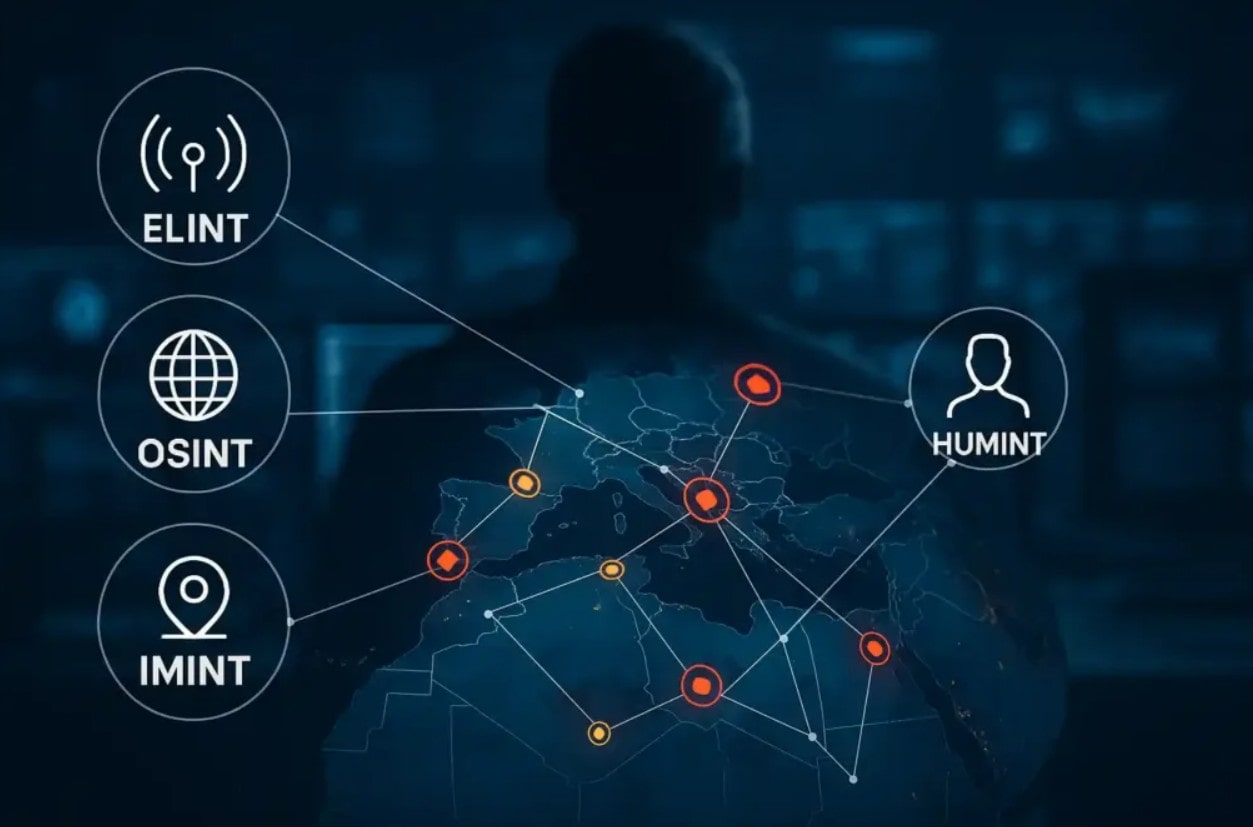
In today’s data-driven and security-focused world, intelligence gathering has evolved far beyond traditional espionage. Governments, military organizations, corporations, and security agencies rely on multiple intelligence disciplines to understand threats, predict risks, and make informed strategic decisions. These intelligence types are classified based on source, collection method, and analytical purpose.
This article provides a complete and structured overview of intelligence types, including SIGINT, IMINT, SOCMINT, HUMINT, and many others, offering clear explanations for each.
What Is Intelligence in Modern Context?
Intelligence refers to processed, analyzed, and actionable information collected to support decision-making. Unlike raw data, intelligence is evaluated for reliability, relevance, and intent. In modern systems, intelligence integrates human input, technology, digital platforms, and scientific measurement tools.
The rise of cyber warfare, social media manipulation, and satellite surveillance has expanded intelligence beyond traditional boundaries, making multidisciplinary intelligence analysis essential.
Major Types of Intelligence (Complete List)
🔍 Intelligence Types Overview Table
| Acronym | Intelligence Type | Description |
|---|---|---|
| HUMINT | Human Intelligence | Information collected from human sources |
| SIGINT | Signals Intelligence | Intercepted electronic communications |
| COMINT | Communications Intelligence | Voice, text, and data communications |
| ELINT | Electronic Intelligence | Radar and weapon system signals |
| FISINT | Foreign Instrumentation Signals Intelligence | Missile and weapons testing signals |
| IMINT | Imagery Intelligence | Satellite and aerial imagery analysis |
| GEOINT | Geospatial Intelligence | Location-based and mapping intelligence |
| MASINT | Measurement and Signature Intelligence | Scientific and physical data analysis |
| OSINT | Open Source Intelligence | Publicly available information |
| SOCMINT | Social Media Intelligence | Intelligence derived from social platforms |
| CYBINT | Cyber Intelligence | Intelligence from cyberspace |
| TECHINT | Technical Intelligence | Foreign technology and equipment analysis |
| FININT | Financial Intelligence | Financial flows and transaction tracking |
| BIOMINT | Biometric Intelligence | Biometric and identity-based intelligence |
| MEDINT | Medical Intelligence | Health and biological threat analysis |
| ECONINT | Economic Intelligence | Economic capability and risk analysis |
| POLINT | Political Intelligence | Political systems and power structures |
| MILINT | Military Intelligence | Armed forces and defense capabilities |
Core Intelligence Disciplines Explained
HUMINT (Human Intelligence)
HUMINT is intelligence gathered through direct human interaction, including agents, informants, defectors, interviews, and interrogations. Despite technological advances, HUMINT remains critical for understanding intent, motivation, and insider perspectives that machines cannot capture.
SIGINT (Signals Intelligence)
SIGINT involves intercepting and analyzing electronic signals. It is divided into COMINT (communications), ELINT (electronic emissions like radar), and FISINT (signals from weapon tests). SIGINT plays a central role in national security, counterterrorism, and military operations.
IMINT & GEOINT
IMINT focuses on visual intelligence from satellites, drones, and reconnaissance aircraft. GEOINT expands this by combining imagery with geospatial and geographic data, enabling precise location analysis, battlefield mapping, and infrastructure monitoring.
Advanced and Specialized Intelligence Types
MASINT (Measurement and Signature Intelligence)
MASINT detects unique physical signatures such as chemical traces, nuclear radiation, acoustic signals, and electromagnetic emissions. It is essential for identifying weapons of mass destruction and covert testing activities.
CYBINT (Cyber Intelligence)
CYBINT addresses threats originating in cyberspace, including state-sponsored cyberattacks, malware campaigns, hacking groups, and dark web activity. It has become one of the fastest-growing intelligence disciplines in the digital age.
FININT (Financial Intelligence)
FININT tracks money flows, banking records, cryptocurrency transactions, and financial networks. It is widely used to combat terrorism financing, money laundering, and organized crime.
Open-Source and Social Intelligence
OSINT (Open Source Intelligence)
OSINT is derived from publicly accessible sources such as news websites, academic journals, government publications, and open databases. It is cost-effective and legally accessible, making it a backbone of modern intelligence analysis.
SOCMINT (Social Media Intelligence)
SOCMINT is a specialized subset of OSINT focusing on social media platforms like X (Twitter), Instagram, TikTok, Telegram, and forums. It is used to analyze public sentiment, social movements, radicalization trends, and information warfare.
Emerging Intelligence Domains
BIOMINT & MEDINT
Biometric and medical intelligence support identity verification, border security, pandemic preparedness, and biological threat detection. These fields gained prominence after global health crises and advancements in biometric technologies.
ECONINT & POLINT
Economic and political intelligence help assess state stability, policy direction, sanctions impact, and geopolitical risk. Corporations and governments alike rely on these insights for long-term planning.
Why Multidisciplinary Intelligence Matters
No single intelligence type is sufficient on its own. Modern intelligence operations rely on fusion analysis, combining HUMINT, SIGINT, OSINT, GEOINT, and CYBINT to build accurate and actionable intelligence pictures. This integrated approach reduces blind spots and improves strategic foresight.
Final Thoughts
The intelligence landscape continues to expand with technological innovation and global complexity. Understanding different intelligence types—from traditional HUMINT to advanced SOCMINT and CYBINT—is essential for professionals in security, defense, cybersecurity, policy analysis, and risk management.
As information becomes both a weapon and a resource, intelligence disciplines will remain at the core of modern power and decision-making.